SHROUD OF TURIN
PICTURE TOUR
WITH DR. JOHN DESALVO
PAGE 1 of 5
Dr. John DeSalvo, the
Director of the Great Pyramid of Giza Research Association (www.gizapyramid.com), was also one of
the scientists studying the Shroud of Turin for over 30 years. John is Executive Vice President for the
Association of Scientists and
Scholars International for the Shroud of Turin (ASSIST), which is the largest and
oldest Shroud research organization in the world. He has lectured nationwide
on the Shroud and the International Platform
Association designated him as one of the top 30 speakers in the nation in 1980. He has
published several articles on the Shroud and is the contributing science
editor for the book Sindon, a Layman's Guide to the Shroud of
Turin (out of print).
This section on the Shroud
of Turin is part of the web site of the Great Pyramid of Giza Research
Association.
Please visit our complete web site at.
www.GizaPyramid.com
This picture tour can also be
reached directly at
www.ShroudTour.com
BEGIN THE
TOUR
(There are five
pages)
The Shroud of Turin is a piece of ancient linen cloth that measures about
14 1/2 feet long by 3 1/2 feet wide (exact dimensions are 14' 6"
long by 3' 9" wide), and on this cloth is a very faint imprint
of a human being who appears to have been crucified. Legend has it that
this Shroud is actually the burial cloth of Jesus Christ. The Shroud
takes it's name from its present location which is in the Cathedral of John
the Baptist in Turin Italy.
SLIDE 1 - Present
location of the Shroud in the Cathedral of John the Baptist. Photo taken
during the 1978 public exposition.
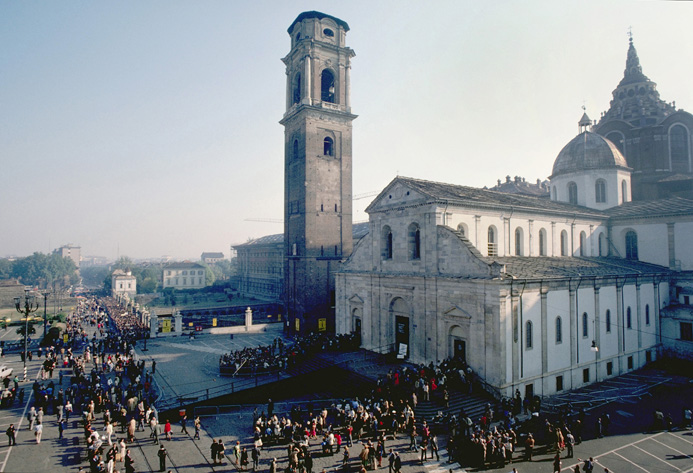
©1978
Barrie M. Schwortz Collection, STERA, Inc.
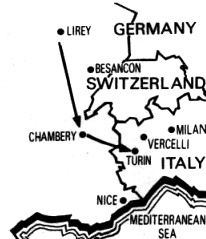
Historically, we can only document the precise location of the Shroud from
1357 to the present. This is important because if the Shroud is a
forgery it would have to have been made prior to 1357. In that year, the
first known public exposition of the Shroud was held in Lirey, France.
From Lirey, the Shroud went to Chambery, France. While in Chambery,
in the year 1532, there was a fire in the Chapel in which the Shroud was
kept. Fortunately, very little damage was done to the Shroud. We
will be looking at the damage on the Shroud due to this fire. Than
in 1578 it was brought across the Alps to Turin, Italy where it remains to the
present.
SLIDE 2 - Locations
of the Shroud from 1357 to the present.
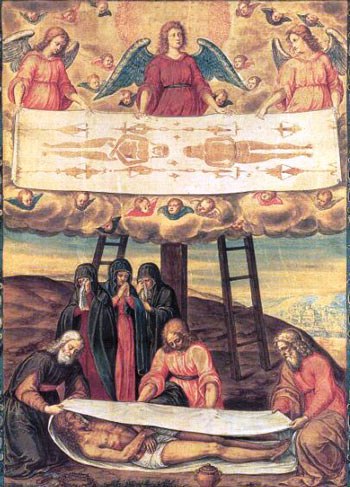
This is a 17th century painting
showing how the body of the man in the Shroud would have to have been wrapped in order
to produce the imprints on the Shroud. The body was first
placed on half the cloth with the head in the center, and then the other half
of the cloth was folded over to cover the rest of the body. Notice how
this would result in both a front and back imprint on the Shroud which would
be head to head.
SLIDE 3 - 17th
Century Painting of the Shroud
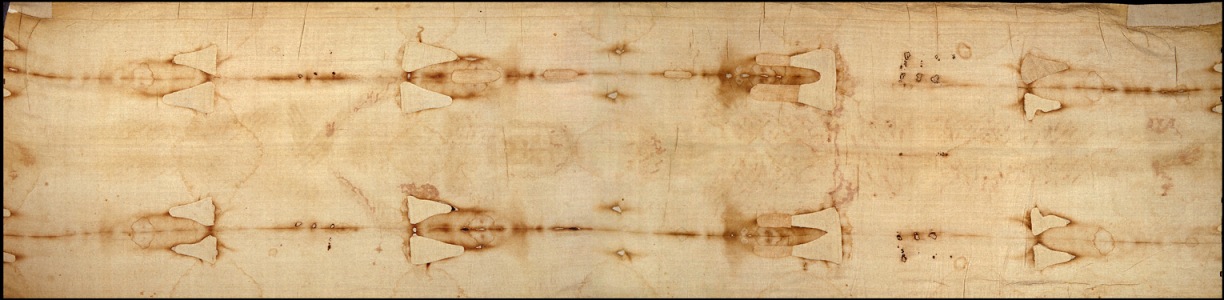
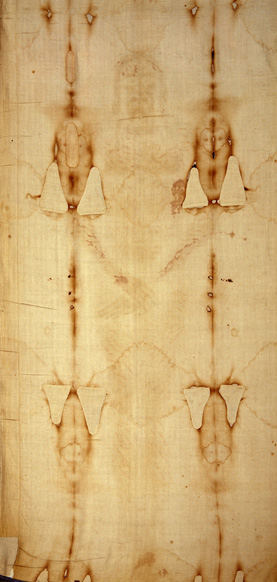
This slide shows the Shroud
as it would appear to the naked eye. The Shroud is marked with burns, scorches,
and water stains from the 1532 Chambery fire. The two dark parallel
lines running lengthwise are scorch marks from that fire. Framed between
these lines is the faint body image, both frontal and dorsal. The
triangular shaped areas are patches sewn on in 1534 to cover up the areas
destroyed by the fire. These patches were removed in 2002 which we will
discuss. The Shroud was folded up and a corner was burnt
by melted silver and this produced the regular pattern of
triangular shapes that you see. The several large diamond shaped areas
are water stains. There are also areas that appear to be blood.
SLIDE 4 - The
Shroud as it appears to the naked eye
©1978
Barrie M. Schwortz Collection, STERA, Inc.
The Shroud is amazing
because only in the last 100 years has man developed the technology necessary
to unlocks its secrets. In 1898 a remarkable discovery was
made. In that year, during a public exposition of the
Shroud, the first photographs were taken by a lawyer named Secondo
Pia. As he was developing his negative plate, instead of
seeing a faint, flat image of a human being, he saw a clear and well defined
portrait of a human being with relief and depth. He thought he was
seeing a miracle but it didn't take him long to realize what had
happened. There, on his negative plate was a positive image. That
is a true image with lights and shadows in there correct relationship.
If he had a positive image on his negative plate, that meant he must have
photographed a negative image since you would get a reversal of lights and
shadows on the negative. Thus, this mean that the Shroud body image was similar
to a photographic negative. How could this be since photography
was not invented until the 1800's and we know the Shroud existed at least
since 1357, hundreds of years before the invention of photograph. Go to
Slide 6 to see what appeared on Secondo Pia's negative.
SLIDE 5
-
The frontal image of the Shroud as it appears to the naked eye
©1978
Barrie M. Schwortz Collection, STERA, Inc.
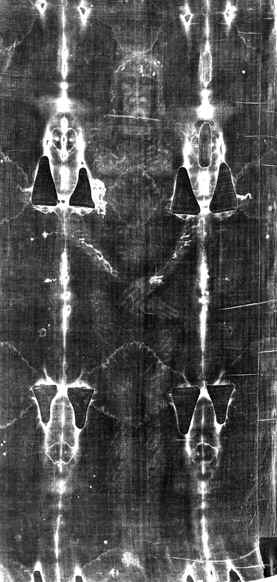
The same frontal image as
it appears on the photographic negative. Notice the body is now a
positive image. The lights and shadows are in their correct
relationships.
SLIDE 6 - The frontal image
of the Shroud on the negative plate
©1978
Barrie M. Schwortz Collection, STERA, Inc.
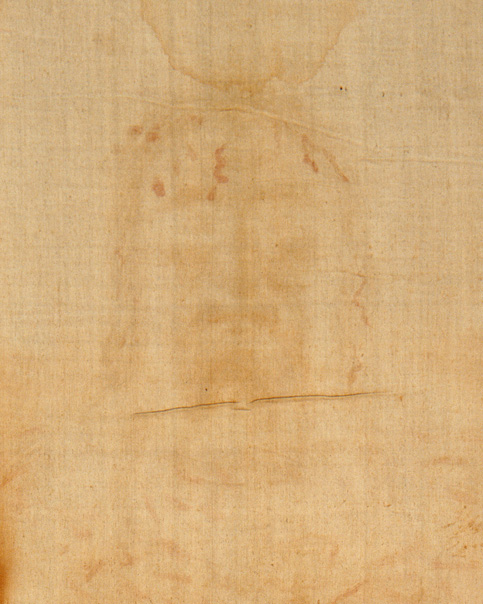
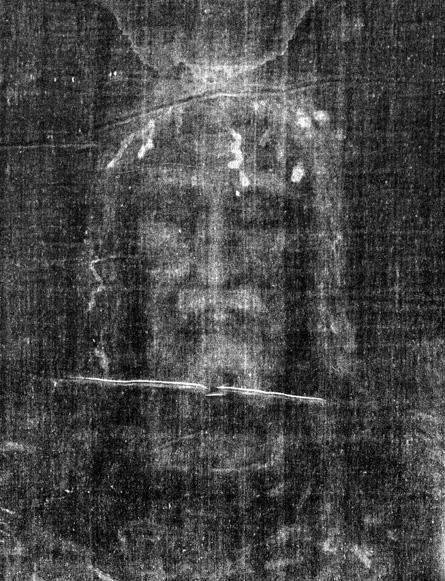
Comparisons of the
shroud as it appears to the naked eye (left) and the image on a photographic
negative (right).
SLIDE 7
- Comparisons of negative and positive
images
©1978
Barrie M. Schwortz Collection, STERA, Inc.
©1978
Barrie M. Schwortz Collection, STERA, Inc.
GO
TO PAGE 2