On August 26, 2006 it was rumored (see message board) that Egyptian authorities were preparing, or, indeed, have already prepared, for another assault on the doors in the southern airshaft in the Queen’s Chamber.
In the spring of 1993, a tiny, video camera equipped robot was dispatched deep into the southern airshaft of the Queen’s Chamber, in search of a solution to continuing ventilation problems. After climbing about 200 hundred feet into the pyramid’s core masonry, the robot encountered what appeared to be a stone slab that had been dropped into the steeply angled shaft and secured with copper pins. There was a small gap at the bottom of the slab, where one corner appeared to have been deliberately shaved off, but the camera was mounted too high to look through.
For many the discovery of what came to be known as “The Door” was the most exciting event in the history of the Great Pyramid. Unfortunately, Egyptian authorities dismissed the door as meaningless, denied the possibility that anything of importance might lie beyond, and no further research was permitted (at least publicly!). According to the narrative, because the door had been placed in such a narrow shaft (approximately eight inches square), it was only a symbolic barrier for the Pharaoh to pass through on his way to heaven. They’d evidently forgotten the complete lack of evidence for the pyramid being a tomb, not to mention that this particular shaft originated in the Queen’s chamber!
Several years later, a second robot was dispatched into the shaft to drill through the door and pass a video camera into the void beyond. Although supposedly live, the embarrassingly unprofessional production was seen as little more than money making sham which ended seconds after the camera passed through the hole in the door and revealed what appeared to be another stone barrier behind it. It was not explained why the video camera, which had previously been able to look back at the robot that carried it, remained perfectly rigid beyond the door. Since that time, there have been numerous rumors of continued exploration, but no really reliable information or published results.
If this latest rumor is true then Egyptian authorities are now, and quite suddenly, not only committed to studying the door and to finding whatever may be beyond it, but also allowing “The whole world to see.” (That or they’ve already completed their explorations and will be “Treating” us to whatever they deem suitable material – or should I say propaganda.) Even now, it remains unclear if the event will be televised live or if it will be pre-recorded (as seems most likely), but, given the history of the Queen’s Chamber airshaft, I would be safe to assume that not many people will be holding their breath.
So, will this latest attempt – if it is to transpire – include smashing the first door and drilling through the second? Perhaps smashing both would be the fastest way to find out if anything of value lies beyond.
But then perhaps drilling or smashing anything was and is completely unnecessary. The pyramid’s designers evidently expected somebody to find that door. If they didn’t also expect attempts to bypass it, why make it so (relatively) easy to find and circumvent the shaft that houses it? In fact, why include the shaft at all, why not do a better job of hiding or protecting whatever it is that is hidden higher up?
Could the door be a vehicle to simply record a given location within the shaft?
This is not the only area of the pyramid that appears to have been “marked.” Could it be that the pyramid’s designer fully expected the door to be found, but wished to stall exploration just long enough for this location to be noted?
If the answer is yes, then simple logic would dictate that the pyramid’s designer also provided a relatively easy way to bypass the door once future explorers had paused long enough to note its location. Is there a simple way to open the door?
Lifting the door would be difficult at best, especially with the copper pins installed near its upper edge. Even if the door could be lifted, it would almost certainly need to be secured in the raised position before we could proceed. Pushing the door would appear to be pointless. Even if it is not “slotted” into the shaft and is capable of movement, it will still block the shaft, regardless of how far we pushed it. If the door is smashed, the resulting rubble will have to be removed – piece by piece – before we can continue. Surely, if the pyramid’s designer wished exploration to continue, an easy method of moving the door would not only be supplied, but also made patently obvious.
Is this, in fact, the case?
The shaved corner at the bottom of the door would appear to be that patently obvious solution. All the designer had to do was provide a suitably sized cavity beside the door, into which it could be slid or flipped.
Flipped?
Sliding the door would require almost as much power as lifting it, but flipping it sideways, over a suitably sized obstacle would be easier (considerably less weight to move) and more effective (the door would be out of the way but in no danger of falling back into place).
Could this be how the door was designed to “work”?
One man was smart enough to find the hidden shaft (way back in 1872) and we now have the technology to probe hundreds of feet into the core of the pyramid. Are we smart enough to bypass the door without blocking the shaft with rubble?
Read on.
Figure 1 shows the door as it is now (sans copper pins and the recently drilled hole). Note that I have included a small step that will be out of sight, to the left of the door. This step, if present, will facilitate the simple mechanical action of flipping the door sideways and out of the way. Figure 2 shows exactly how the idea might work.
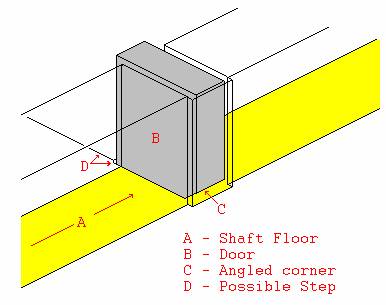
Figure 1: Note the small (proposed)
step to the left of the door. Any attempt to lift the door by its lower
right-hand corner would result in it “Flipping” to the left and into this
(proposed) cavity. Surely the simplest method of moving the door.
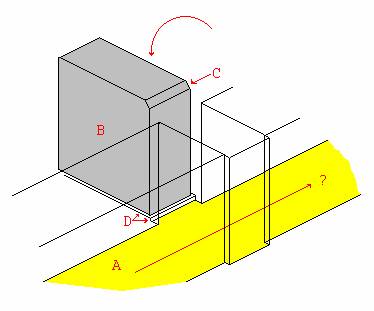
Figure 2: With the door (doors?)
safely aside, exploration can continue.
There is one final scenario to ponder. Those who designed and built the Great Pyramid possessed a level of technology that we are only now beginning to suspect is, or was, far superior to our own. We know that their technology included machinery that was both sophisticated and powerful enough to carve the hardest stone with unnerving precision, but we have no idea what powered it.
Did these people have electricity?
Will the copper pins at the top of the door make or break a connection if we move it?
Could the door trigger something if it is moved?
Could the door trigger one specific result if it is moved correctly (say, flipped sideways), and another if it is moved incorrectly (smashed or pushed)?
Could we be rewarded for one action and punished for another.
Were we supposed to find that shaft in a more scientific manner than simply suspecting it was there and smashing a hole in the wall?
Will we ever know the truth?
Copyright © 2006, Steve Bedford. No part of this article may be reproduced without the written permission of the author.
Please note: The author openly solicits comments with respect to the above article, and would specifically like to hear From Dr. Zahi Hawass (via a route that can be authenticated, of course). Please feel free to write to rjnowski@golden.net or simply post your comments on this site’s message board. Steve Bedford