The e Proportion: The Euler Number and the Great Pyramid
Rick D. Howard's derivation of the e proportion and its relationship to pyramid geometry.
SECTION II. THE e PROPORTION:
Given a right triangle :
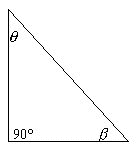
with an assumed ratio :

And knowing there are 180-degrees in a triangle, we solve for the angles beta and theta using degrees for easy visualization.
Solving for angle beta and knowing
the sum of angles for a triangle is 180-degrees we have : 
So it follows : 
Substituting theta into
we have : 
Reciprocating both sides : 
Simplifying : 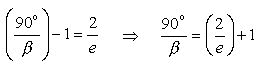
Reciprocating both sides again : 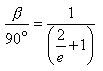
Multiplying both sides by 90 : 
Factoring 1/e out of the denominator and simplifying : 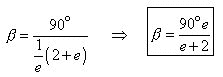
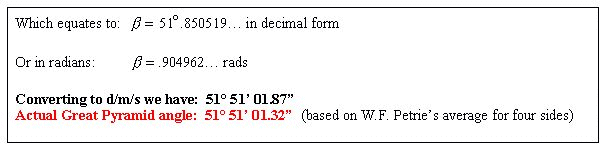
Solving now for angle theta
The assumed ratio :
From the triangular identity :
so it follows : 
Substituting beta into
we have : 
Simplifying : 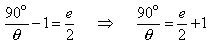
Reciprocating both sides : 
Multiplying both sides by 90 : 
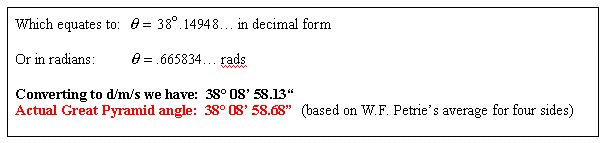
Factoring 1/2 out of the denominator and simplifying : 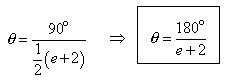
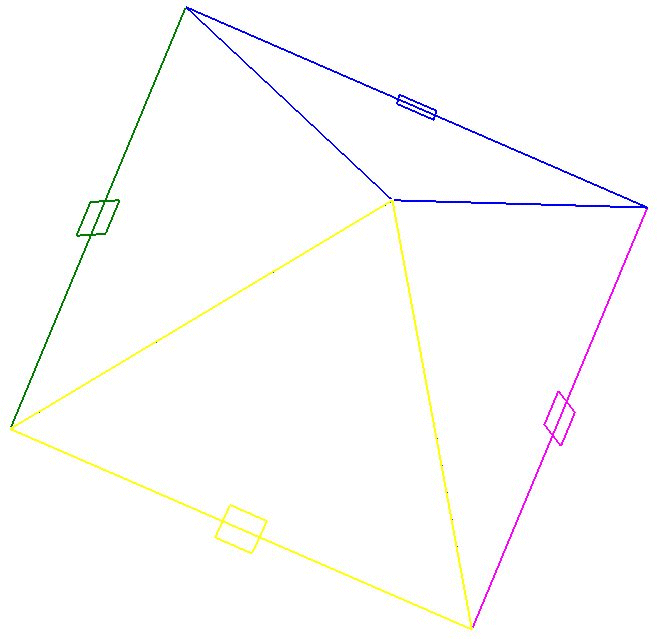
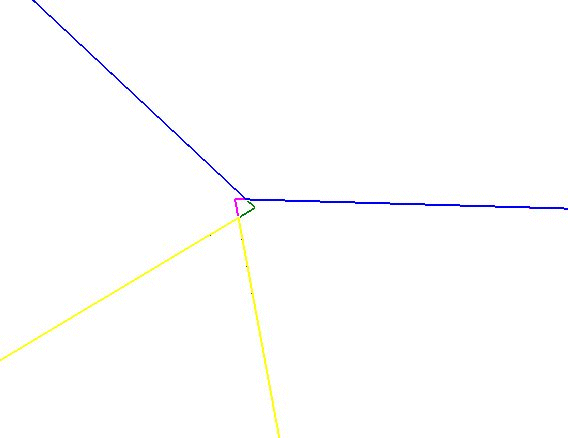
Shown above is a computer pyramid model with a square base. In each quadrant the three independent triangular models; e, Pi and Phi are represented with the addition of the Pyramid Pi as the fourth side. The image on the left is a top-down view with the image on the right showing an extreme close up at the apex. Here we can begin to see the misalignment in the geometry, but only at very high magnification. Modeled by Tim Alison.
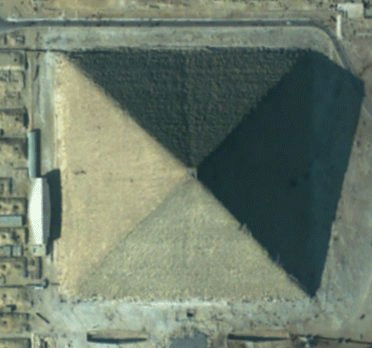
What follows is the main purpose of this paper; the Triple-Triangle-Theory.