The Fourth Dynasty Great Pyramids - Geographical Orientations and Side Deviations, Part One
Ernest Moyer demonstrates that the misalignment of the pyramids from true north was intentional design, showing a controlled monotonic decline from Meydum through Giza, revealing the sophistication of the pyramid builders.
Copyright 2001, by Ernest P. Moyer
Introduction
In two seasons from December 1880 to May 1881 and from Oct. 1881 to April, 1882 Sir Flinders Petrie made accurate triangulations and measurements of the pyramids at Giza. His results showed a consistent compass misalignment west of north on all sides of the two largest pyramids. Petrie's mean value was -3' 43" for the Khufu casing (Giza 1); his mean value for Khafre (Giza 2) was -5' 26". In 1925 J. H. Cole repeated measurements on Giza 1 to verify Petrie's precision and accuracy; he obtained a mean skew of -3' 06".
In 1973 G. S. Pawley of the Physics Department of Edinburgh University in Scotland and N. Abrahamsen of the Geophysics Laboratory of Aarhus University in Denmark refuted several suggestions put forth to explain the misalignment.
Rejected Explanations
Petrie assigned the skew to shifts in the north pole position. He discussed changes in ocean currents as a probable cause. However the true pole position is moving at a rate of about 0.0032" annually at Cairo (Giza). Over a period of 4500 years this change would amount to no more than 0.24', far less than necessary to explain the skew.
The misalignment is also not due to continental drift. South America is separating from Africa at the rate of about five centimeters per year with a continental hinge in the north Atlantic. This would cause a shift of about -0.1' over 4500 years, again far too small to produce the measured misalignment. Africa is also swinging away from Asia with a hinge near the north end of the Red Sea but this is of the wrong sign and also too small to produce the skew.
Another factor is local earthquakes. Although the pyramids show evidence of quake damage, historical and geological data show no earthquakes during the past 4500 years of sufficient magnitude to produce such dramatic results.
Pawley and Abrahamsen then went on to state that the pyramid skew should be explainable in geophysical terms although no physical cause is currently known. They also remarked that no other remains in Egypt can give corroborative results; the two pyramids at Giza are unique; other pyramids are smaller and less accurate.
The Intentional Design Hypothesis
Examination of data from other structures, with comparison against Giza 1 and Giza 2, shows that the skew of the largest IVth dynasty pyramids is due to conscious control by the builders and is suspect for evaluating past geological changes. A more comprehensive review is helpful to arrive at better estimates of builder measurement and construction control.
I compiled data from Petrie, Cole, Vyse, and Maragioglio to obtain a more rigorous assessment of the misalignment and its possible impact on our understanding.
Table I: Base Lengths and Orientations
Significant Egyptian IIIrd and IVth Dynasty Pyramids Base lengths in meters. Orientations from true north in minutes and seconds. Negative sign indicates west of north.
Key Measurements
ZOSER STEP
- Length: 125 E-W by 108 N-S
- Orientation: 4° 35' E of N
MEYDUM
- Base: ~144 meters
- Orientation: Approximately -24' (west of north)
BENT (Dashur)
- Base: ~189 meters
- Orientation: Approximately -17' (west of north)
FLAT (Dashur)
- Base: ~220 meters
- Orientation: Approximately -9' (west of north)
GIZA 2 (Khafre)
- Base: ~215 meters
- Orientation: -5' 26" (Petrie)
GIZA 1 (Khufu)
- Base: ~230 meters
- Orientation: -3' 43" (Petrie), -3' 06" (Cole)
GIZA 3 (Menkaure)
- Base: ~108 meters
- Orientation: Near 0' (approximately true north)
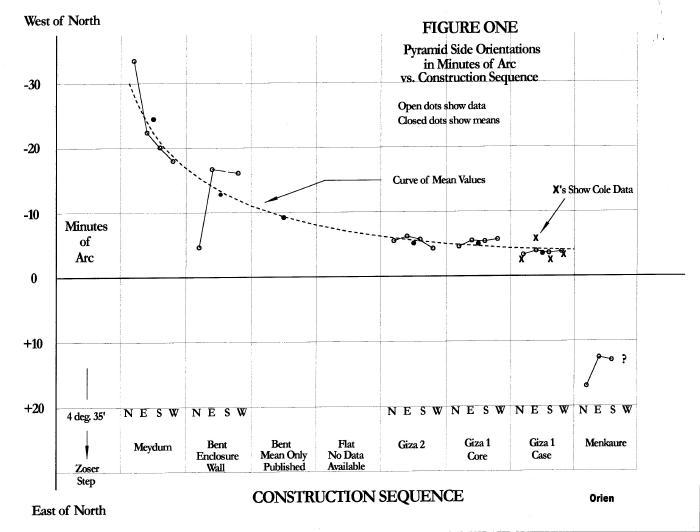 Figure 1: Compass alignments of the respective structure sides in sequence N-E-S-W
The Monotonic Decline Pattern
When the orientations are plotted in sequence from Meydum through the Giza pyramids, a striking pattern emerges: a smooth, monotonic decline in misalignment from approximately -24' at Meydum to near 0' at Giza 3 (Menkaure).
This pattern cannot be explained by:
- Random construction errors
- Geological processes
- Continental drift
- Pole wandering
- Earthquake effects
The probability of such a smooth progression occurring by accident is vanishingly small.
Implications of Intelligent Control
If this pattern is due to intelligent control, the data would demand that the designers and civil engineers intended to display such refinement to later observers. It makes no sense to exercise such control unless they expected that someone could later discover it.
Certainly, no observer in historic times, over the past four millennia, and especially not today, would credit such a remarkable display as under intelligent control.
In fact, not until modern times did we have the ability to detect such refined control. After the Menkaure pyramid such control was lost to the world.
Design Requirements
If the monotonic decline was through design intent, the control necessary to display it would be nearly equal throughout the entire construction period. Otherwise, the designer could not ensure that the smooth decrease would be apparent to later observers.
He had to maintain intentional misplacement from the pole position at a refinement necessary to bring out the display. This fact leads to the inference that the builder was able to control misalignment from the beginning with a finesse equal to the control exhibited in Giza 1.
The Meydum Connection
Importantly, the Meydum structure appears to be part of a grand design that was used to demonstrate ability to control geographical orientation. If the designer/engineer held the separate structures to intentional misalignment he was controlling how this orientation would appear to some later researcher who might assemble the data according to the plot shown.
The sequence tells us that:
- The project was planned as a unified whole from the beginning
- Meydum was the starting point for demonstrating orientation control
- Each successive pyramid reduced the skew in a controlled manner
- The builders possessed extraordinary measurement and construction capabilities
Construction Sequence Insights
The plot tells us the sequence - if we are willing to accept that the builders had the sophistication to plan and execute such a demonstration. The traditional chronology places these structures in the following order based on dynasty assignments, but the orientation data may tell a different story about actual construction sequence or planning.
Conclusion
The geographical orientations of the Fourth Dynasty pyramids represent another level of sophistication in the Grand Design. The controlled progression from -24' at Meydum to near perfect alignment at Menkaure demonstrates:
- Advanced surveying capabilities - The builders could detect and control orientation to within minutes of arc
- Long-term project planning - The entire sequence was planned from the beginning
- Intentional communication - The pattern was designed to be discovered by future observers with sufficient measurement capability
- Mathematical sophistication - Understanding of true north, angular measurement, and precise control
This evidence, combined with the mathematical relationships in pyramid dimensions, passage angles, and construction techniques, points to a level of knowledge and capability that challenges conventional assumptions about the Old Kingdom period.
The pyramid builders were not primitive peoples struggling with crude tools. They were sophisticated engineers and mathematicians who left a message in stone for those who would have the capability to read it.
References
- W. M. Flinders Petrie, The Pyramids and Temples of Gizeh, Field and Tuer, London, 1883
- J. H. Cole, Determination of the Exact Size and Orientation of the Great Pyramid of Egypt, Survey of Egypt, Paper #39, Government Press, Cairo, 1925
- G. S. Pawley and N. Abrahamsen, Journal of the Institute of Archaeology, 1973
- H. Vyse, Operations Carried out at the Pyramids of Egypt in 1837, J. Fraser, London, 1840-1842
- V. Maragioglio and C. Rinaldi, L'Architettura delle Piramidi Menfite, Rapallo, 1964
Ernest Moyer is author of "Our Celestial Visitors," in which he thoroughly examines the UFO and abduction phenomenon, with much new material never before published.