Anatomy of the King's Chamber
Bernard Pietsch's detailed analysis of the King's Chamber construction, revealing sophisticated engineering and mathematical relationships.
The Well Tempered Solar System
Anatomy of the King's Chamber
As we make our way through the various interior passageways leading to the center of the Great Pyramid, the awesome quality of the sounds captures our notice. One's voice and even presence becomes an instrument of resound as it strikes some distant wall and summons us to go further into this marvel of architecture.
Near the middle of the pyramid, we ascend the Grand Gallery, pass through the Ante-Chamber and then bend down to enter the low narrow channel that leads to our destination. The floor of this passageway is rough and uneven and we must stoop for 100 inches until we enter the King's Chamber. When again standing upright we see that the chamber, brightly lit by fluorescent bulbs, is twice as long as wide, about 35 feet by 17 feet and nearly 20 feet high.
The chamber is empty save for the rectangular granite coffer at the far end. This is the famous sarcophagus in which the Pharaoh Cheops was thought to be interred. There is no evidence that a body ever occupied the coffer—all is supposition.
Through the years, legions of spiritual pilgrims have come to this room to chant and meditate. Do the seekers fulfill their expectations as they contemplate quietly in the cool granite sarcophagus? Who can say? But what we can submit is that any person, regardless of the nature of his or her quest, merely by entering the chamber, stands in the midst of a truly sacred space. The narrative we are about to unfold is one told by ancient monuments and sacred sites around the world. But here, in the King's Chamber it is revealed with the elegance and simplicity and 20 rectangular forms which make up the floor of the chamber.
As we define sacred, only spaces can indicate the sacred. Sacred knowledge as we intend it, alludes to information that is perfect, idealized, and therefore intangible. One must participate with the sacred in order to realize the higher order of intention it represents.
The 20 rectangular granite blocks of the floor of the King's Chamber, though solid, can also be seen as spaces. Albeit crude approximations of perfect space, the stones delineate the keys to the astronomy that is the foundation of the entire chamber. The floor stones represent six planets: Mercury, Venus, Earth and its Moon, Mars, Jupiter, and Saturn. The message of the chamber is, "The heavens are the foundation of this space. Understanding our place in the synchrony of the solar family is the key. This is where to begin."
We'll adapt a musical analogy to uncloak the harmonies of the planets as they reside in the stones of the floor of the King's Chamber. The process is not exact and a degree of license is required, but the results will lead us to appreciate the intricacies and inter-relatedness of the solar system as never before. Even more astonishing is the realization that the elements of the planets were designed into these simple forms over 5,000 years ago, and that the true music of the spheres is recorded here.
Introducing the Well Tempered Solar System Prior to the invention of tempering, keyboard instruments were tuned by mathematical formula. The distribution of frequencies between notes was regular and specific. The inflexibility of the early system meant that differently tuned instruments were needed to play music written in different keys. The tempered method was developed to allow all musical keys to be played on one keyboard. By adjusting slightly the intervals between tones, all keys could be accommodated. Sacrificing the mathematical purity of the just system allowed for a degree of musical versatility and harmony not previously enjoyed. In much the same manner we are going to "temper" the Solar System.
Purists may argue that the 10 digit numbers we are about to produce cannot be obtained from crude masonry and that "Man cannot disturb the march of the planets." But that is what we will do. The actual will become artful as the intention behind the design is revealed.
By once again summoning K (1.01430555) we part the veil and behold! The distaff elements of the planets are harmonized. Relationships not previously seen are made visible. K renders our Earth-centric filter of 365+ days/year to a geo-metric 360-days/year filter. Days and degrees are now synchronous; e.g., one day in an Earth year will represent one degree of the circle. We propose that the designers of the Pyramid used such a device as K, to translate time and orientation into geometry and measure.
(Note: There are numerous permutations and correlation amongst the planets' periods and rotations. Only a few illustrations are presented here, to give the general reader the flavor of the accomplishment. For serious students of the subject a complete table of the elements of the Well Tempered Solar System is available from the author. If the dance of numbers is not your pleasure, simply savor the imagery they evoke, as we skip about the features of the chamber.)
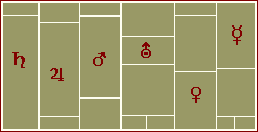
Entering the King's Chamber Having been forced to bend down to negotiate the approach to the King's Chamber, the first thing one observes when entering the room, is the floor. The floor stones are rectangular and arranged in parallel "strips," each strip being a different width.
Directly beyond the entry, lie four stones extending to the far wall. We call this row the Mercury strip. To the right and parallel to the Mercury strip are five more rows of stones we've named the Venus strip, the Earth/Moon strip, the Mars strip, the Jupiter strip and at the far end of the room the Saturn strip.
The first stone upon which we stand upright is named after Mercury, Messenger of the Gods and Communication. It is Mercury, first planet in the solar system which initializes our circuit around the room. Mercury is the swiftest in its orbit and its quick cadence imprints the whole solar family. In theWell Tempered Solar System, Mercury's movements are part of the huge choreographed dance of the planets' periods, rotations and harmonics. Mercury's influence permeates the other planets in the system, and the dimensions of its stone counterpart infuse the geometry of the other stones in the chamber as well.
Recalling thatK****(1.01430555)is the ratio between the solar year of 365+ days and theCanonYear (also called Sacred Year of 360 days, wherein 1 day =1460.6minutes) we undertake the process of "tempering" by adjusting ever so slightly the conventional astronomical value of the planets byK. Mercury's year of 87+ earth days divided byKbecomes theCanonperiod for Mercury:
87.06****1.01430555=85.83333 CanonDays in Mercury's year. Likewise, we "tune" Mercury's rotation period (astronomically 58+ days) byK:
58.04****1.01430555=57.2222 CanonDays = 1 Day on Mercury It is now easy to see that Mercury's orbit divided by its days of rotation is1.5. In other words, in one Mercury year, Mercury has one and one-half of its own days.
A stepping stone to its solar cousins, the first stone in the Mercury strip, stone1Ais peculiarly endowed with numbers relating to Saturn. If speedy little Mercury corresponds to the snare drum in the rhythm section of an orchestra, large and ponderous Saturn is like the bass. Solemn and unwavering Saturn carries the beat for the whole band. We can see the interplay between Saturn and Mercury in the following example.
In the chamber we find the number for Mercury's year sandwiched between the relationship of the widths of two stones in the Mercury strip, stone1Cand stone1D. The length of stone1Cat29.469444inches represents theCanonorbit of Saturn at29.469444years. The length of stone1Dhas to betunedjust a bit from 34.34317751 to34.33333to get a perfect number. Multiply the ratio of the two by 100, and we have theCanonvalue of Mercury's year in days:
(29.469444 34.333333) x 100 =85.83333 days/year of Mercury The Mercury strip is63.81262190inches wide. Divide this by ten and see that the number in the Mercury strip is the same number as the distance Saturn's equator rotates in one second of time:6.381262135 Canonmiles.
Notice that we began inches and ended in miles. This telescoping of relationships between units is more than numerical slight of hand. It is a statement about the underlying relationships between units in theCanonsystem and thescaleof relationships between the planets. There are many instances where the lower order of a measure, much like the lower octave of a note, is manifest in the higher order or octave of a planetary attribute. The units may be different(e.g. years or degrees) but the resonance is apparent. The relationships occur because theCanonitself is grounded in the natural order. Indeed, if illumination is effected, it is to realize profoundly that we are a part of the natural order. The only planets we may ever know are the planets within.
In oneCanonEarth day, (1/360thCanonEarth year or 24 hours 20 minutes 36 seconds) Mercury rotates 2 x π degrees or 6.283972726 degrees.
The number of square inches on top of the whole Mercury strip is131,454,000. Taken as feet, we have an indicator for the number of feet the Earth rotates on the equator in oneCanonDay of 24 hours 20 minutes 36 seconds:131,454,000 feet.
The reciprocal of131,454,000x 1^11is the same number as the number of feet on the front of Cheops Pyramid:
(1131,454,000) x 1^11=760.722382**** The number760.722382has a nearly metaphysical relationship to gravity and time. If divided by 100 and taken asseconds7.60722382, it is the answer to the following riddle: An object falls 47.2 feet in 2 seconds. If a pendulum is the same length in height, (47.2') how long would it take it to swing back and forth one time? It would take7.60seconds. This observation is significant because it incorporates the knowledge of the "second-second" in its formulation. In order to understand the "first" second i.e. to be able to measure the distance of fall of an object in one second, the present moment must be extended/suspended in order to examine (measure) the "second" second of fall. Without appealing to the second-second, we would never notice that the distance of fall in the second-second is greater than the first and thus that the rate of fall is accelerating. Ironically, because we can never getoutof the first second of our experience, the conceptualization of the second-second is a highly sophisticated device. Our experience is alwaysnow, but by borrowing on our past experience we presume the future and realize that our present is accelerating.
**760.**722382 as millimeters or (30 inches) of Mercury is the standard mean reading of barometric air pressure.
The volume of the second stone in the Mercury strip1B, 53519.60278 cubic inches, divided by 100 and taken to its natural logarithm is 2 times π:
[(53519.60278100)^-e] =6.282633087 6.2826330872 =3.141316543 It also happens that the square root of the same volume (53519.60278), divided by 100 and taken to its natural logarithm is the same number:
√535.1960278=23.13430413^-e=3.141316543**** When Mercury rotates through one degree of its circumference, Earth has rotated57.2222. It takes Mercury57.2222 Canondays to turn one rotation on its axis or complete one of its own days.
In53.045days Mercury will have reached the, φ point222.48(the golden proportion of 360 of its yearly orbit, and will haverotatedthrough333.333degrees of its day.
Mercury's rotation through333.333degrees takes**.927**of its day.
57.2222 53.045 = .927 .927 x 2 x 100,000is theCanonsignification for the speed of light:185,400 Canon mps. 92,700,000 miles is the mean radius of Earth's orbit, or one Astronomical Unit.**** Another reference to theCanonspeed of light number is found by applying the tempering process to the period Saturn, wherein one year of Saturn becomes10609 Canondays, during which time there are185.4days of Mercury:
10609****57.222=185.4signification for the speed of light at 185,400 Canon miles per second. The diagonal angle of Mercury Stone1Ais 30 40' 06". This is also Mercury's approximate orbital inclination to the (mean) celestial Equator.
Stone1Cin the Mercury Strip is29.469444" long. As years it represents one orbit of Saturn. By "tuning" slightly the length of stone1Dfrom 34.3417751" to34.3433333", we can derive a perfect ratio between the two stones:
(29.4694444x 100)34.333333=85.833333the days in Mercury'sCanonyear. (2 x 34.3333 x 10 =686.6666, theCanondays in Mars year.) 686.666(x 10) is also found as the surface area of Mercury1A:6866.666sq. inches.**** The surface area of the top of the first stone in the Mercury Strip1A, divided by 10 signifies the number ofCanondays in Mars' orbit:(63.812 x 107.607) 10 =686.666days.
There are 12 days of Mercury in one Mars' year:686.666****57.22222= 12.
There are 8 Mercury years (orbits) in one Mars year:686.666 85.8333= 8.
During one Saturn year,10,609days, Mercury will have completed 66666.666 of rotation, or will have reached the 333.333 point 200 times.
The length of Mercury1Ax 100 is representative of the number of Earth calendar days (24 hours) in Saturn's year:10760.76763. The width of1A, 63.81262195" divided by 10 signifies the number ofCanonmiles 6.381262195 that the equator of Saturn will rotate (5258.16 feet to the mile) In one second of time, Saturn rotates 6.38126295 miles on its equator. Saturn's equator would then be 236,617.2 miles in circumference. As previously discussed inSaturn Source of Measure, Saturn figures heavily in ancient art and the origin of measure.
The surface of Mercury stone1Ahas6866.727967 square inches. Divide by 10 and see a referent for Mars'Canonperiod of686.66666days/year.
The volume of1Ais 73512.14044 cubic inches. Multiply that by 100 and take the common log:6.866359069. Multiply by 1000 and we are very near to the square inches on the top surface of1A:6866.727967 square inches.
107.6076763thelengthof stone1Ax 100 is the exact same number ofsquareinches on the surface of Saturn Stone6B:10,760.76763square inches.
In the Mercury Strip the total number of square inches on the top surface of the four stones, multiplied by 10,000 and taken as feet, signifies the number ofCanonfeet in the circumference of the Earth:
206" x 63.81262195" = 13145.400 x 10,000 =131,454,000**** The cubic inches in the whole of Mercury1Cis 6325.459147 cubic inches or3.660566636 cubic feet. Times 100 see Earth's sidereal year in days:**366+**days.
The length of the entire Chamber is412inches. The width is206inches. The perimeter of the Chamber is1236inches. In one orbit of Saturn, there are123.6orbits of Mercury:
1060985.8333=123.6**** The width of the chamber206inches (17.166 feet,) divided by 10 connotes the Common Cubit of20.6inches. Read as a sexigesimal number 20.6 would be 20 minutes 36 secondsthe difference between Earth's Calendar Day of 24 hours and theCanonEarth day of 24 hours 20 minutes 36 seconds.20.6is a principal figure in theCanonsystem. Divided by 2, it represents the ratio between the major to minor axis of the orbit of earth: 1.03. When multiplied by .03,20.6becomes the ratio of the golden proportion..618.
The surface area of4Cin the Mars strip is 3333.333 square inches. Divided by the Common Cubit of 20.6 inches and again by 100, we derive the golden proportion number1.618122977(perfectCanonvalue).
The height of the chamber from floor surface to ceiling is230.2585093inches. Divided by 100, the height of the chamber signifies the ratio between the system of common and natural logarithms:
10^-e= 2.302585093 When the height of the chamber is taken from the bottom of the wall (which is beneath the level of the floor) to the ceiling, it measures235.6463942inches. Taken as seconds of time we find a referent for the difference between the mean solar day of 1440 minutes and the mean sidereal day of 1436.07 minutes:
1440 - 1436.0725 = 3.92743 minutes difference. 3.92743 minutes x 60 =235.6463942seconds.**** The Earth Strip,3A,3B,3C, and3D+3Eis87.636inches wide. As seconds,87,636is the number of seconds in oneCanonEarth Day of24.343333hours. There are also8763.6hours in oneCanonEarth year of 360 days.
In stone3Bof the Earth Strip, the length is46.69246833inches. As 4.6692 we recognize the value forchaos. The diagonal angle of the top plane of3Bis 28.04869487 degrees. We take that as a referent for the number of degrees in the Moon's upper node, from which tidal harmonics are initiated. That this figure would be linked to the value forchaos, is interesting.
The diagonal angle on the surface of Earth Stone3Ais32.14521358, indicator for "g" approximating the gravitational number of feet in the secondsecond-of-fallof an object.
The tangent of that angle, .6283990122 divided by 2 and x 10 is a close approximation for the value of π.
The largest stone in the Earth Strip3Cis83.63715584" long and87.836" wide. The surface area in square feet represents the mean number of seconds of precession of the equinoxes:50.90seconds of arc per year:
(83.63715584 x 87.636)144=50.90017909 square feet**** The diagonal angle of stone3Dof the Earth strip is 26.19222679 degrees, indicating the inclination of the Earth's orbit read magnetically: 26 19'+. This is also the degrees of inclination of the passageways.
Earth stone3Eis 45.75693065" long by 20.6" wide. The length, times ten is 457.5693065. The common log of this number is 2.660456884, or the co-tangent, when seen as an angle, of20.6", the width.
The Saturn stone6Bin the Saturn Strip, is185.4" long,58.0408179012" wide and10.70555595" deep. Each of these dimensions is significant:
185.4is the number of times Mercury rotates on its axis in one orbit of Saturn. 185.4also stands for 185,400Canonmiles/second, as the speed of light. 58. 0408179012" indicates the E days (24 hours/day) of Mercury's rotation.**** The surface area on top of Saturn6B=10760.7676383square inches. As days, the area represents the number of calendar days in Saturn's year:10760.7days.
Also: Saturn's Calendar Period divided by the perimeter of the room (divided by 10) equals the Calendar days in Mercury's year:
10760.7676383****123.6=87.06122685137days.**** The diagonal length on the top surface of the Saturn Stone6Bis16.18939479', divided by 10 signifying the golden number:1.618.
The volume of Saturn Stone6Bis 66.66666 cubic feet.
If the Saturn Stone6Bwere gold, it would weigh 80,000 lbs. Troy.
If the Saturn Stone6Awere gold, it would weigh 8,888.888 lbs. Troy.
Saturn stone6Bis 9 times the weight of Saturn stone6A.
The volume of the entire chamber (from ceiling to the bottom of the walls which are beneath the floor) 206" x 412" x 235.64" =20,000,000cubic inches.
The volume of the floor alone, multiplied by 1000, approximates the value for the number of minutes in the year:
(206" x412"x10.70555595"= 908601.86 cubic inches, the volume of the floor) 908601.86 cubic inches 1728 (cubicinches to one cubic foot) x 1000 =525,811.3105. As minutes/year, this figure is a departure of 8.1103456 cubic inches, from a perfect525,816minutes in oneCanonyear.)**** The width of the Chamber,206inches is related to anotherCanonmeasure rooted in the heavens. The reciprocal (120.6) of the number of the Common Cubit, x 100 is4.854368932inches, the measure called the Handbreadth or Palm. The Handbreadth times 360 and divided by 100 gives us another ancient and powerful measure we believe was the original Jewish Remen:17.47572816". The reciprocal of the Remen x 100 is the day of Mercury:
(117.47572816) x 100 =57.22222theCanonday of Mercury**** The length of the Saturn Stone6B, 185.4 inches, divided by the Remen x 1000 produces theCanonperiod for the orbit of Saturn, 10609 days:
185.4****17.47572816x 1000 =10609Saturn's year inCanondays.**** The length of the Saturn Stone6B, 185.4 inches, divided by the Handbreadth, taken to its reciprocal and multiplied by 1000 renders the sexigesimal number (unconverted) of the inclination of the magnetic orbit* and angle of the Ascending and Descending Passages:
185.4****4.854368932x 1000 = 26.1832197 or26 18' 32"**** Stepping over to the 5^thstrip we call the Jupiter strip, we'll see how incestuous our little solar family is.
The Jupiter Stone5Bis151.767633inches long.151.767633is also the difference between the calendar days of Saturn and its counterpart inCanonDays:
10760.76763( Year In E Days)K=10609 CanonYears. 10760.76763****10609=151.767633the difference between the two types ofyear, calendar andCanon.**** Jupiter's year is4,333.333Earth days of 24 hours each. There are104,000hours in that time. If that period is divided by the number ofdaysin oneCanonyear of Saturn, we get the number ofhoursin one day on Jupiter:
104,000 10,609=9.802997455 hours of Jupiter's rotational day**** In4333.3333Earth days (one year of Jupiter) there are or11.8637550 Earth calendar years. During that time, Jupiter will have had10,609of its own days during one full orbit. Notice the simile between Jupiter and Saturn: each shares10,609but in its own way. There are10609 CanonEarth days (24 hrs. 20 min. 36 sec.) in Saturn's orbit. There are10609JupiterCanondays in its orbit.
There are10760.76763square inches on the top of Saturn Stone6B. The calendar year of Saturn10760.76763days, has258,258.4232periods of 24 hours. Divide by ten and see this as representing the number of years in the precessional cycle:25,825.84232years.
On the top plane of the Jupiter Strip5A, the side length of34.3333inches is shared with the side length of Saturn stone6A,20.6". The relationship of the two is:34.3333****20.6=1.6666, the ratio for decimal to sexigesimal timing:100****60.
The synchronistic relationship between Saturn and Jupiter is again embellished by the interplay of the two stones6Band5B. On the east side of Saturn6Bthe side length (185.4") is adjacent to the longest length in5B, the Jupiter strip (151.7676"). Subtracting the length of the Jupiter stone5Bfrom the number of square inches on the top of Saturn stone6Bextracts the number ofCanondays in Saturn's year from the number of Calendar years:
185.4x 58.04 =10760.76763(area sq." top surface6B)**** The number of square inches on the top surface of Saturn6Bwhich identifies the calendar days in Saturn's orbit, minus the length of Jupiter stone5Bin inches, yields theCanonperiod of Saturn's orbit:
10,760.7676- 151.7676 =10,609the number ofCanondays in Saturn's year.**** The walls of the Chamber descend about half way beneath the top and bottom surfaces of the floor stones. When the floor stones are seen as "inserted" between the walls, the perimeter of the bottom of the wall as it were, bifurcates the floor stones into two layers, creating a double set of stones.
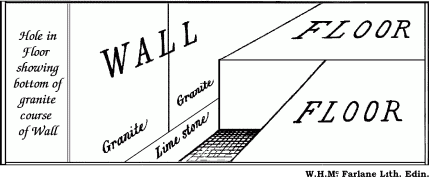
In a sense, there are now 60 stones indicated in the floor — 20 actual and 40 derived. A set of 20 stones contrived on the top "half", and a set of 20 on the bottom "half". Each set gives different information. We may consider the major diagonals, the areas, surfaces and volumes of the top and bottom portions of each stone and the ratios between them.
The depth of the stones to the level of the bottom of the wall is5.387884927". This top layer we'll designate as levela. The bottom layer,bis slightly smaller at5.317671023". The total actual height of the floor stones is10.70555595".
The height of the lower portion of the floor stonesb,5.317671023"is related to the speed of light. Its reciprocal divided byKis theCanonvalue for the speed of light:
(1****5.317671023) x 1,000**=**18805.22499
18805.22499K=185,400 Canonmiles/sec.**** The bottom portion of Mercury1D/bhas a cubic volume of 3661.616349 cubic inches. Divided by 10 and seen as366.16days it represents the Earth's sidereal year. The cubic inches in the bottom portion of Mercury1A/bis 36515.00. Divide this by 100 and we have the indicator for Earth's solar year:**365+**days.
There are three interesting ways that π is indicated in the Mercury strip:
First, the total volume of Mercury stone1Bdivided by 100 has a natural logarithm of two times π:
(53519.60278cubic inches 100)^-e2 =3.141316543 Secondly, thetopportion of Mercury stone1C/ahas 3183.472784 cubic inches in volume. The reciprocal of 3183.472784 10,000 = .0003141224 x 10,000 = π ≈ 3.141224.
Third, the volume of thelowerportion of Mercury stone1C/bis 3141.986361 cubic inches. Dividing by 1000, renders the exact value ofCanon π at3.141986363.
The volume of Mercury1Bis 30.97199235 cubic feet, another referent for Mercury's orbital inclination: 30+ degrees.
If Mercury1Bwere gold, it would weigh 37166.39082 lbs. troy. Divide by 100 and then by 60, to derive the decimal number for the last quarter day of Earth's year: 6.19439487 or 6 hrs 11 min 39 sec .8344.
The width of Mercury1Cis29.4694444inches. This is the same number as the number of calendar years in Saturn's orbit:29.469444years.
The area of the long side plane of the bottom portion of Mercury1A/bis 572.2222218 square inches. Divide by 10 to find57.2222, the number ofCanonEarth days in one day of Mercury, ie. one rotation on its axis.
107.6076763" x 5.31767102" = 572.2222218 10 =57.22222 Notice that the volume of the bottom portionbof Saturn Stone6bis also57222.222cubic inches. Divided by 1000, it is again, the number ofCanondays in one rotation of Mercury:57.2222days.
The total volume of the Saturn Stone6Bis 115,200 cubic inches, or 66.666 cubic feet. Curiously, 66.666 times1.03, (which is the ratio of the Earth's major to minor axis) gives us 68.6666, which multiplied by 10, is the period of Mars:686.666 Canondays.
The complexities we have just touched upon, beg the questions, "What was the initiating point for reconciling the multiplicity of variables in the design? "Where did the designer start?"
There is a certain book of aphorisms which says: "To know means to know all. To know a part of something means not to know. It is not difficult to know all, because in order to know all one has to know very little. But in order to know this little one has to know pretty much." (P.D. Ospensky inThe Fourth Way.) The design of the King's Chamber begins with "one thing," and that one thing is a totality. Like other aspects of the Great Pyramid, it is built out of the knowledge of wholeness. All the parts must work together. Ultimately the one thing is us--our physiology, our life experience, our ability to perceive the instant--we are our vehicle. In an imperfect world, physical forms can only suggest meaning. Bytuningthe measure of a form ever so slightly, we can apprehend beyond the limitations of the actual form perceived, and divine as it were, more than is given. If we can see theintentionof the architect, it may be possible to glimpse the whole.
Just as the whole pyramid is informed from "the top down" the individual parts are derived from the whole. As discussed previously, the "missing" top of Cheops Pyramid is neither missing nor existent. As metaphysical construct, its elusiveness lies in the nature of its apprehension. Since it is not physical, it can only be comprehended intellectually. In theTimaeus, Plato speaks of a "third nature, which is space, and is eternal, and admits not of destruction and provides a home for all created things, and is apprehended without the help of sense, by a kind of spurious reason, and is hardly real." (page 457 section 52,The Great Booksversion.) In this purity of space, the laws are expressed in mathematics and geometry, uncorrupted by physical form. Here the gods consort with number, geometry and physics, co-mingling their various parts. Diversity results from the coalescing of a few simple attributes: height, width, volume etc. The seeds of measure--the second of time, the weight of gold, and the one-second pendulum are conceived here. When transposed to the physical world these heavenly notions become susceptible to the limits and vagaries of time and material. We can glimpse them dimly through the portal of number and divine what perfection they intend.
Thespaceabove the 206^thcourse of Cheops, projected from the physical stone to a point above the pyramid though invisible can be said to have a form extrapolated and extended from the physical pyramid. Within this empty pyramidal shape, angles, dimensions and volume can be derived. From the measures, significance can be intuited. For example: The cubic volume of the extended pyramidian would be 17,526.01662 cubic feet.
Thecommonlogarithm of that volume is4.2436. Multiplied by 10,000 is42,436which has a square root of our old friend,206, as inches, the width of the King's Chamber.
Thenaturallogarithm of the same volume (the empty top) is9.771441472. If this number is taken a 9.771441472inches, and used as a pendulum's length, that pendulum would have a period ofone second of time.
The ratio between all natural and common logarithms of numbers is2.30258503. For example the natural log of the pyramid's empty top, 9.771441472 the common log of empty top, 4.243683112 equals2.30258503
In the King's Chamber we find this number2.30258503(times 100) as the height,230.258503inches, of the wallsabovethe surface of the floor.
The whole Mercury Strip, if it were gold, would weigh97728.34478lbs. troy. That number divided by 10,000 and seen as inches would be the length of aone-second pendulum:9.77inches.
Whether as9.771441472, or as**.9771441472or97.71441472this number appears in numerous places in the pyramid and other structures. Hatshepshut's obelisk at Karnak is97.71441472feet high. In Luxor there were two Obelisks dedicated to Ramses. The first is977.1441472inches high. If that length were a pendulum, it would have a10-secondperiod. The second smaller obelisk, now in Paris at the Place De La Concorde, is77.74feet high. If its height were a pendulum, its period would be9.771441472**seconds.
In the King's Chamber, 977. appears in the relationship between the volume of the upper part of the floor (that portion of the floor which is between the walls) and the empty space above the floor. The pure space above the floor is 19,542,882.944 cubic inches. This space in the chamberplusthe portion of the solid floor which extends to the bottom of the walls, has a volume of 20,000,000 cubic inches.
The ratio of the two volumes: 20,000,000 19,542,882.944 = 1.0233904.The reciprocal of 1.0233904 is**.9771441472** 977. approximates the number of ounces in one cubic foot of water.**** The interconnection between Saturn, "Initiator of Time" or "Kronos," with the Common Cubit of**20.6"**is pervasive throughout the Great Pyramid.
- The width of the King's Chamber is 10 times the Common Cubit, or**206"**inches.
- There are206originalcoursesin the body of Cheops Pyramid.
- In206yearsthere are 7 orbits of the planet Saturn.
- 20.6is theminutesdifference between the solar day of 1440 minutes and theCanonDay of 1460.6 minutes. (Refer to our previous chapter on the Great Pyramid.) An average or mean number is another method of encoding wholeness.206is a prime demonstration of a Saturn number embedded in the wholeness of the chamber. Take for example theaveragetop surface area of an averaged stone from the floor:
206"x412"= 84,872 square inches in the floor. Divide by 20 to find the average stone's top surface:4,243.6square inches. Translate the number of square inches into the number of square feet by dividing by 144. There are29.469444square feet per average stone, or the same number as the number of Earth years in Saturn's orbit:29.469444years. The number of square inches in the average stone,4243.6divided by 10 is also the same number as the Common Cubit squared:20.6^2=424.36.**** Invoking Mercury, messenger of the gods to transport us to another dimension, we take20.6^2divided by the area of Mercury1Dto get a close approximation to the weight of 1 cubic foot of water:
The top surface area of1D(34.64317751 x 20.0498165) is 694.5893521 square inches. (20.6^2694.5893521) x 100 =61.095. 61.095identifies the number of avoirdupois pounds per cubic foot of water.**** The Mercury Stone1Dif it were goldwould weigh 5163.864702 lbs. troy. Bytuningthe weight to a perfect 5162.8333, we'll see an inkling of the origin of a system of weights and measures which relate to time. Dividing 5162.8333, a weight, by101.430555, (Kx 100 and also the number of feet in theCanonsecond of arc on the equator) we arrive at a cosmic measure of time associated with the annual number of seconds of arc of the precession of the equinoxes:50.9009788". The perfectCanonvalue would be50.90017909. Interestingly, the reciprocal of a pure50.90017909x 100 renders the ratio between the weight of one cubic foot of gold and one cubic foot of water:19.64462963.
The whole Mercury Strip, stones**1A, 1B, 1C, 1D,**has a volume of 81.44028733 cubic feet. If the entire mass of the strip were gold, it would weigh 97728.34478 lbs. Troy. That number divided by 10,000 and seen inches would be the length of a one-second pendulum:9.77inches.
Another underlying octave of the precessional cycle reveals itself when Saturn's orbital period in calendar days, multiplied by the number of 24 hour periods in that time, is seen as years:
10760.76763days x 24 hours = 258258.4232 10 =25,825.84232years.**** The synchronicity continues between Jupiter, Saturn and Earth. The ratio between Jupiter's rotation4333.33333(in Earth calendar days of 24 hours) and Saturn's rotation10760.7676383(in Earth calendar days of 24 hours) is2.483254070512.Earth'sCanonday of1460.6hours divided by this ratio is the number of hours assigned to the rotation of Jupiter: 9.802997454996 or 9 hours 48 minutes.
There's more: The major diagonal length of Saturn Stone6Bis194.5696792inches. If a pendulum that length were to beat for oneCanonEarth day of1460.6minutes, there would be 19639.22215 full periods. Dividing 19639.22215 by 1000 =19.639another close approximation to the ratio between the weight of one cubic foot of gold and one of water.
The surface diagonal of the same stone6Bread in feet is approximately 10 times the golden number:16.18939479.
What is the origin of theCanongrain? The grain is transliterated from the abstraction of time. The mean solar day of1440minutes minus the mean sidereal day of1436.07minutes, derives a difference which when squared is the ratio of grains to one gram:
3 minutes 55 seconds or3.927422^2=15.42447076gr./gm**** As previously discussed, there is aqualitativedifference which distinguishes theCanoninch from the conventional inch. Even though we use the word "inch" and an ordinary ruler for measuring objects, theessenceof theCanoninch is much more complex and dynamic. TheCanoninch is subservient to time and the instant. It is the philosophical measure of being in the moment. As every moment in an expanding universe is singular, so is the inch. From the observation of the action of a simple pendulum, we may experience the variety of "the moment." Just as no two moments are the same, no interval of the pendulum is the same as the last. To casually say they are identical is to rob the instant of its individuality. Ideally, any experiment or observation would be qualified by the degree of departure however slight, of the behavior from the mean measure used to quantify it. Thisresidual factoror departure from the mean, regardless of how small, is information about the influence of the environment of the experiment, whether it's human input, a local influence or a cosmic one.
So it is that from the timing of the pendulum one of the most elemental of units, the number of grains to one gram of weight is embedded with another fundamental unit of length, theCanoninch.
We start with theCanoninch, and find the period of one inch as a pendulum, a moving weight in space. The period is .3199 seconds of time. In one period of .3199 seconds the pendulum will have swung to and fro, and the Earth will have rotated through479.85feet on its equator:
479.85is the number ofCanongrains in one troy gram of gold (Conventionally 480 gr./gm). It must be appreciated that the source ofCanonmeasure is neither cultural nor conventional, nor even historical in its development. It is rooted in the very nature of universal dynamics. Our genetic apparatus is at the effect of those dynamics and we through our physiology are recipients of that inheritance. It would not be surprising if in the not so distant future it is found that the human genome and theCanon of Measureare inscribed by the same precursors to human evolution. And that the genesis of number itself is a natural exteriorization or projection of the planetary dynamics and biological cycles resident within us.
We can propose that some systems of metrology may have grown out of geometry itself. For example, avoirdupois weight has an interesting relationship with the cosine of 45 degrees. (We use the conventional term "avoirdupois" simply for convenience. Though not derived by this method, the modern ounce is nearly the same as theCanonounce.)
Begin with the cosine of45degrees = 0.7071067811. Use this as the tangent of an angle. The angle is: 35.2643896 degrees. The reciprocal of of 35.2643896degrees, times 1000, is the number ofgramsto one avoirdupois ounce: 1 35.2643896 x 1000 =28.357218400 grams to the ounce.**** The persistence of these various relationships suggests an ancient recognition of the elemental connection between systems of linear measure, volume, weight, and the abstraction called gravity. TheCanoninch, the gram of gold, (both avoirdupois and troy weight) the weight of water and the function of the pendulum, form an inseparable amalgam withtimethe conceptual seeds from which the fruits of ancient measures arise. The smallest unit abides with the grandest, from the inch to the precession of the equinoxes. All are complementary. From knowing one, it is possible to discover the others.
In our next segment we will continue our exploration of the King's Chamber with special attention to the granite sarcophagus, the "Pillar of Orichalcumupon which are inscribed the Laws." (Plato,Critias.)
APPENDIX
The following reference is from a conventional astronomical table for the elements of the planets. It can be noted that astronomical assessments for the orbits of the planets vary from one reference to another. Mean periodicities are derived from observation and attendant reconciling astronomical theories. With at least 5,000 years of modern astronomical invention at hand, one must by comparison, assent to the clarity of vision of the ancient astronomer
From Peterson Field Guides: Stars and Planets, 1995
Mercury**:**
Rotation: 58.646 E days
Synodic Period: 115.9 E. days
Sidereal Period 87.96 E days
Venus**:**
Rotation: 243.01R E days
Synodic Period: 584.0 E days
Sidereal Period: 224.68 E days
Mars**:**
Rotation: 23h56m04.1s
Synodic Period: 779.9 E days
Sidereal Period: 686.95 E days
Jupiter**:**
Rotation: 9h 50m > 9h 55m
Synodic Period: 398.9 E days
Sidereal Period: 4337 E days
Saturn:
Rotation: 10h 39.9m
Synodic Period: 378.1 E days
Sidereal Period: 10,760 E days
Mercury**:**
Rotation: 58.65 E days
Synodic Period**:**115.88 E days (opposition to opposition)
Sidereal Period: 87.969 E days Venus**:**
Rotation: 243.01 E days
Synodic Period: 583.92 E days
Sidereal Period: 224.701 E days Mars:
Rotation: 24.6229 E hours
Synodic Period: 779.94 E days
Sidereal Period: 686.98 E days
Jupiter**:**
Rotation: 9.841 E hours
Synodic Period: 398.99 E days
Sidereal Period: 11.8623 E years
Saturn**:**
Rotation: 10.233 E hours
Synodic Period: 378.09 E days
Sidereal Period: 29.458 E years
Mercury:
Rotation: 58.646 E days
Synodic Period: 115.88 E days
Sidereal Period: 87.97 E days
Venus:
Rotation: -243 E days
Synodic Period: 583.96 E days
Sidereal Period: 224.7 E days
Earth:
Rotation: .997 days
Synodic Period:
Sidereal Period: 365.26
Mars:
Rotation: 1.026 E days
Synodic Period: 779.94 E days
Sidereal Period: 686.98 E days
Jupiter:
Rotation: .41 E days or 9.8400 hours
Synodic Period: 399 E days
Sidereal Period: 4331.9836 E days
Saturn:
Rotation: .43 E days
Synodic Period: 378 E days
Sidereal Period: 10742.2966 E days
Copyright 2000 by Bernard I. Pietsch.
For more articles please visit Bernard Pietsch's web site at:http://www.sonic.net/bernard/